Trains are a great way to see the scenery of Japan, but they can quite often be busy and crowded, especially in urban areas. Bear in mind these guidelines to make travelling by train as stress-free as possible, both for you and your fellow passengers.
Many of the guidelines for travelling by local train are the same as for travelling by Shinkansen, but there are a few differences. These are what you should be aware of:
Take as little luggage as possible, especially if your journey involves a change of trains. Especially especially if you only have a few minutes to change. If you have large suitcases, consider sending them by takkyubin.
On the train, put your luggage on the luggage rack or hold it on your lap. Don’t put it on the seats.
Try not to take a four-person berth with only two people or one person.
Don’t use the priority seats if there are other seats available. (The priority seats are normally at one end of the carriage, and they have notices prominently displayed.)
If you do sit in the priority seats and someone who needs them gets on the train, give up your seat to them.
Make sure you get ready to get off in plenty of time to be able to leave the train. Most services don’t stop for more than a few seconds really. If you start getting your luggage ready once the train arrives at the station, in all likelihood you won’t have time to get off.
If you’re sitting on a bench seat (one of the long ones along the side of the carriage), refrain as much as possible from eating or drinking.
This should go without saying, but don’t put your feet on the seats. This is especially frowned upon if you’re wearing shoes.
Don’t be too loud. It’s okay to speak while on the train, but try to do so in a low voice. Don’t be too raucous: ideally, the people in the seats behind you shouldn’t be able to hear enough of your conversation to be able to follow along.
Put your phone on silent mode while you’re on the train, and refrain from making or taking calls.
Don’t stand near the doors, or if you have no alternative, make sure you move to let people on or off at stations.
Does this sound overly strict? Don’t worry: it’s basically just manners and common sense.
Do you have any more guidelines to add? Please let me know in the comments!
Once or twice a week, I have to walk past quite a large rice field. As the year progresses, it’s always fascinating to see how the seasons change, as reflected in the rice field.
Right now, the field is bare. It’s just brown earth with a few dead stalks, presumably from last year’s rice plants, mixed into the soil. Now we’re in February, though, it won’t be too long before the farmers start to flood their fields and then plant their rice seedlings.
Thinking about it, rice planting must be- or, at least, have been- a back-breaking job. Nowadays it’s done mainly by a little planting machine on which the farmer rides. (By the way, the machines are apparently incredibly expensive, especially given that realistically, they’re used once a year.) But I’d say that even now, in the corners of fields and places where the planting machine can’t get to, the job is still back-breaking because the farmer has to plant every single rice plant by hand, individually. You can see why more and more people are retiring from rice cultivation, and why fewer and fewer young people are choosing it as a job.
It’s a real shame, really. And maybe it’s a bit of a chicken and egg situation, but it’s noticeable how much the rice fields- in this area, at least- have declined in number over the past few decades.
Saijo, where I live, is famous for sake. In fact, it’s one of the three largest sake-producing regions in Japan. It’s always said that it’s partly because of the water, partly because of the climate, and partly because of the rice. But it really is quite noticeable, and in a way quite amazing, how much the rice fields have declined in number. You have to wonder how much longer rice farming will be a viable thing in these parts, and that begs the question, will there come a time when Higashihiroshima City is no longer renowned for its sake?
I used to love Tonomi Station because it was old, a little bit ramshackle, but it was how it had always been, and it was wonderful. But a few years ago, the station building was completely rebuilt. It’s very bright and airy, and really it is a much nicer building, but it’s much simpler and it lacks the rundown, old-fashioned charm of the original station building.
And then on platform three (which is actually the only other platform) there used to be a big wooden shelter, almost as big as a barn in a way, with seats inside it, but now that’s gone completely, and all that’s left is just three rows of seats out in the open on the platform, which is fair enough, but if it’s raining, you can’t use them at all. At least on platform one, there is the station building which provides shelter. It’s progress in one way, I suppose, but, in another way, very much not so. Sometimes with the JR Sanyo Line west of Iwakuni, I get the feeling that for the lesser stations, it really is a case of managed decline. I very much hope that I’m wrong.
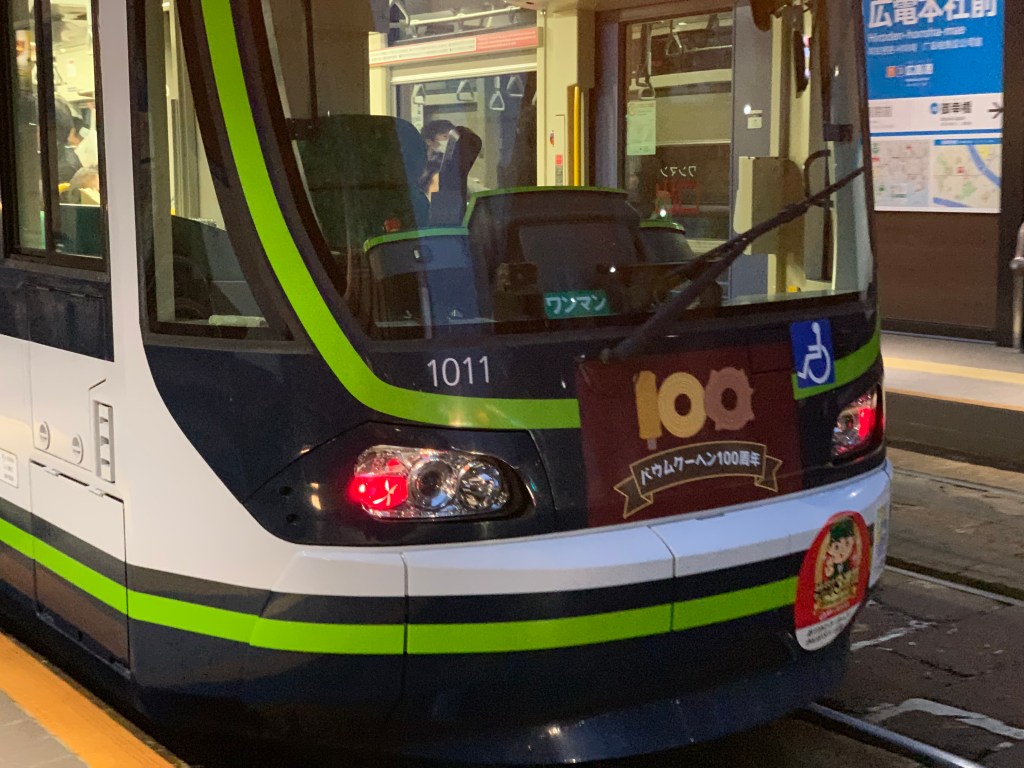
I’ve just seen a young man on the tram in Hiroshima, with a huge roll of masking tape on his arm, like an outsized bangle.
I’m sorry, I’m not even going to attempt to ponder why this might be. I just hope he’s heading to do some DIY or something. The alternative… Well, I dread to think!
Oh my goodness. I’m normally listening to music or a podcast, so I’ve never noticed before, but the current chimes before announcements on Hiroshima trams makes it sound like you’ve reached a whole new level on a video game.
You’ve probably heard of a chocolate teapot, as in the phrase ‘as useless as a chocolate teapot’.
But what about a concrete ship? This might sound as crazy as a chocolate teapot, but in fact, concrete ships — that is, ships built out of concrete — did actually exist.
What’s more, two of them still do exist, and are recognisable as ships. They can be found in Hiroshima Prefecture, in Yasuura, Kure City. They’re called Dai-ichi Takechi Maru (第一武智丸) and Dai-ni Takechi Maru (第二武智丸), but in this article, I’ll call them Takechi Maru 1 and 2 respectively.
Anyway, a bit of history.
During World War II, Japan was short both of cargo ships and of steel that could be used for shipbuilding. It was decided that building reinforced concrete cargo ships for the Imperial Japanese Navy would be a way to save steel, and a concrete cargo ship was designed. The main design work took place in Maizuru, which even today remains a major naval base. The design was based on the E-type standard wartime design, and the concrete ships were therefore known as the EC-type standard wartime design.
(By the way, in case you’re wondering, the thickness of the concrete hull ranged from 12 centimetres above the waterline to 25 centimetres for the bottom of the ship. The bow was reinforced with steel plate to alleviate any collision damage that might occur.)
View back towards the mainland from Takechi Maru 2. Photograph taken by author.
The first ship, Takechi Maru 1, was built in Hyogo Prefecture, and was completed in August 1944. Equipped with an engine, and with a sailing speed of 7 knots, it was used to transport military supplies.
After Takechi Maru 1, construction of five more ships began, but only two of the five had been commissioned by the end of the war. The fourth was at the stage of being fitted out when the war ended.
This is probably no reflection on the ships’ design or construction, but the four completed ships seem not to have been blessed with particularly good luck.
Takechi 3 struck a mine and sank off the coast of Shōdoshima (in the Inland Sea) in July, 1945, and Takechi Maru 4 was scrapped after running aground near Kōbe after a typhoon in September 1945.
Also, in May 1945, Takechi Maru 2 struck a US mine while sailing through the Kanmon Straits. However, the damage was minor, and reports state that it was not too different to what a steel-hulled ship would have sustained. So in fact, maybe the concept of concrete ships wasn’t quite so far-fetched after all.
Anyway, by just after the end of World War II, only Takechi Maru 1 and 2 remained. Takechi Maru 1 was abandoned near Kure City, but Takechi Maru 2 was still usable and was sold. However, it was soon withdrawn from service.
So, you might ask, how did two of the ships end up in a small fishing port in Hiroshima Prefecture?
Well, at the end of the war, the fishing port in Yasuura had no breakwater, and as a result, fishing boats were frequently damaged by typhoons. The Yasuura Fisheries Association petitioned Hiroshima Prefecture to construct a breakwater, but the prefecture refused, citing the huge costs of construction.
But this didn’t mean that the breakwater scheme was, well, dead in the water. Instead of constructing a whole new breakwater, the decision was made to use Takechi Maru 1, from Kure Port, and Takechi Maru 2, from Osaka Port, as the breakwater.
The ships were purchased in 1947, and foundation work began in 1949. The sterns of the two ships were connected to each other, holes were drilled in several places in the bottom of the hull, seawater was let into the ships, and they were sunk at high tide.
Actually, I suppose ‘sunk’ isn’t quite the right word, because even now, it’s possible (theoretically, at least) to stand on the deck of the ships without getting your feet wet. Perhaps it would be more accurate to say that the ships were scuppered. Anyway, once on the sea bed at the entrance to the port, they were secured by placing rubble on both sides of the hulls. The work was completed by February 1950.
Apparently, at the time of the work to install the ships as the breakwater, their superstructures were almost intact, but most of the metal structures were subsequently removed, leaving basically only the concrete hulls, and a few metal fittings embedded in the concrete.
Also, at some point in the past, the title ‘Mizu-no-mamorigami’ (水の守り神) was emblazoned on to the side of the hull of Takechi Maru 2 (the ship further from the land), proclaiming both ships to be ‘guardians of the waters’.
Anyway, this brings us to today, 80 years after the end of the war, and some 75 years after the breakwater work was completed. The two concrete ships still remain, and even now, they still act as a breakwater for Mitsuguchi Port in Yasuura. Until relatively recently, it was possible to access the ships, to walk along one side of the hulls and look down into the holds.
Takechi Maru 1 is now listing quite noticeably. Photograph taken by author.
Unfortunately, the ship nearest to the land is listing quite noticeably now, and presumably because of this, the gate to access the ships is locked closed now. The ships themselves are still very visible, though: it’s about a 20-minute walk from Yasuura Station (on the JR Kure Line) to Mitsuguchi Port, from which you can get a fairly close look at them. Alternatively, from the far side of the port, you can get a more long-distance view of the two ships, and their place in the landscape. Low tide affords a better view of the ships.
The two ships seen from the far side of Yasuura Port. Photograph taken by author.
The ships Takechi Maru 1 and 2 fascinate me. Even now, when it’s no longer possible to walk out along them, I still like to visit Yasuura occasionally to gaze out at them; to think again about what they are and what they represent. I think it’s fair to say that they were certainly built out of necessity, and that they wouldn’t have come about had there not been a shortage of steel, but that by no means detracts from the fact that they were indeed built, and that they’re still in fine fettle now. Their construction, and their continued existence, are both pretty improbable, but they demonstrate that war gives rise to situations that would never happen under ordinary circumstances.
It’s amazing to think that these ships are actually physically part of World War II. Put simply, Takechi Maru 1 and 2 are very tangible, concrete- literally concrete- reminders of the history of 80 years ago. Walking on them is walking on history, in a very absolute sense. It’s wonderful that they survive, and that they act ultimately as sobering reminders of war.
But at the same time, it’s also very appropriate and quite fitting, really, that these two remnants of the war are now guardians of the waters. Not only are they tangible and meaningful reminders of war, but they also fulfil the peaceful role of protecting the fishing port in Yasuura. May they continue to do so for many years more.
I noticed a long time ago that the supermarket near where I live plays ‘Singing In the Rain’ as background music when it’s raining. I assume that it’s some sort of signal to the staff, or it might even be for the customers. Anyway, I found out today (don’t ask how!) that it’s not just the local supermarket, and in fact that there are a whole range of signals sent by music in supermarkets. I suppose it’s like a non-verbal version of the London Underground’s ‘Inspector Sands’. Taking Ito-Yokado (a supermarket chain in Japan) as an example, the following tunes mean different things: – Daydream Believer, by The Monkees, is played when there’s nothing special happening; – Help!, by The Beatles, can be played by checkout staff to call for extra help on the tills when there are large numbers of customers waiting; – Carmen, by Georges Bizet, indicates robberies or other crimes in the store; – And (this is one you never want to hear), Symphony No. 5 (1st Movement), by Beethoven (da-da-da-DUM), indicates a bomb threat! Finally, there’s one probably targeted at customers rather than staff. Rhythm of the Rain, by The Cascades, informs shoppers that it’s raining. So, if you’re in a supermarket in Japan, and you hear a rain-related song, you’ll likely need an umbrella when you leave. On the other hand, if you hear Beethoven, it might be a good idea to leave as quickly as you can!
I was on a tram in Hiroshima today. It was a fairly full tram, and just by where I was standing, there was a family: mother, father, and son.
The son was studying math, by the look of it for junior high school entrance exams. Why you would do that on a tram is anyone’s guess, but that’s what he was doing.
Now when Japanese children do maths, they quite often write the math with their finger in the air. Actually, they do that when they’re writing Japanese characters (and practicing English, for that matter) as well.
But what was really quite cute about the situation on the tram was that the young boy was using his father’s back as a sort of slate, or whatever you want to call it, on which to write the equations he was trying to solve.
And the father? Well, he was just taking it all in his stride.
At stations on JR West (and, I think, other JR areas), it’s quite common to see rubbish bins for newspapers and magazines.
Now, given how many people spend all their time on the train using their smartphones (and by extension, not reading newspapers or magazines), I wonder how many people actually use those bins these days. I mean, there must be some, but you just don’t generally see people reading on the train so much these days.
It’s nice that stations still have these bins, but in fact, it’s just harking back to an age that’s basically disappeared now. It’s a shame, really.
If you’ve ever been to a bank or a convenience store in Japan, you might have noticed, tucked away behind the counter but still easily accessible (to the staff, that is), some orange balls. If you look more carefully, you’ll see that they’re actually clear balls filled with some sort of orange liquid. Any idea what they might be?
Well, let me tell you. They’re actually to protect against crimes. They’re called ‘bohan colour balls’ (crime prevention colour balls), but I prefer the alternative (and far more attention-grabbing) ‘crackball’. Whatever the name, the idea is that staff can throw the balls at any criminals who are trying to escape.
Good idea, but it raises one question (actually, several): do the staff actually practice throwing these balls? How do they learn to aim? What if they hit a completely innocent bystander? The whole ‘orange ball’ system just seems very prone to mistakes, let’s put it that way.
I certainly wouldn’t have any confidence that I would be able to hit anyone who’d just stolen something from my shop or, worse still, from my bank… but maybe that’s just me.
Footnote: It appears that people possibly do practice throwing the balls. There’s even a website (unfortunately only in Japanese, but then again, why would it be in any other language?) explaining everything you could ever want to know (and quite possibly more) about how to use the balls.